Which security cameras actually work without a subscription
"Works without a subscription" means three different things, and only one leaves you with footage. Checked against each maker’s own pricing.

Last updated · source-check dates are listed at the foot of this page
On this page
Of the ten brands checked here, four make cameras that work without a subscription and still keep your video: Reolink, eufy, TP-Link Tapo and Lorex. Each records to a card or a hub in your home, so there is no monthly fee.
- Outdoors, no socket nearby: Reolink Argus 4 Pro (paid link) runs on a battery, takes an optional solar panel, and records to a card in the camera.
- Indoors, or near a socket: TP-Link Tapo C120 (2K QHD, indoor/outdoor) (paid link) plugs in, records to a card of up to 512 GB, and is rated IP66 for outside.
- Several cameras in one home: eufy HomeBase 3 (S380) (paid link) is a hub the cameras record to: 16 GB built in, expandable to 16 TB.
- Already own Wyze or Blink? You may need a card or a drive, not a plan: Wyze · Blink.
Matched to where the camera goes, not ranked. Nothing here was tested; every fact is from the maker’s own page.
Something happens at your front door at two in the morning. You open the app before work, and there is nothing there. No clip, no history, nothing to hand anybody.
That is not a fault. On a Ring camera with no plan, it is the product working exactly as sold — you get a live view, and only while you are looking at it. Nothing is kept.
Four other brands do the opposite and record to a card in your hand, free, for as long as the card lasts. Both of those situations get sold under the same four words: works without a subscription. Here is the difference, brand by brand, from each company's own pricing pages.
What are the three kinds of "no subscription"?
Every camera falls into one of three groups, and the group matters more than the brand.
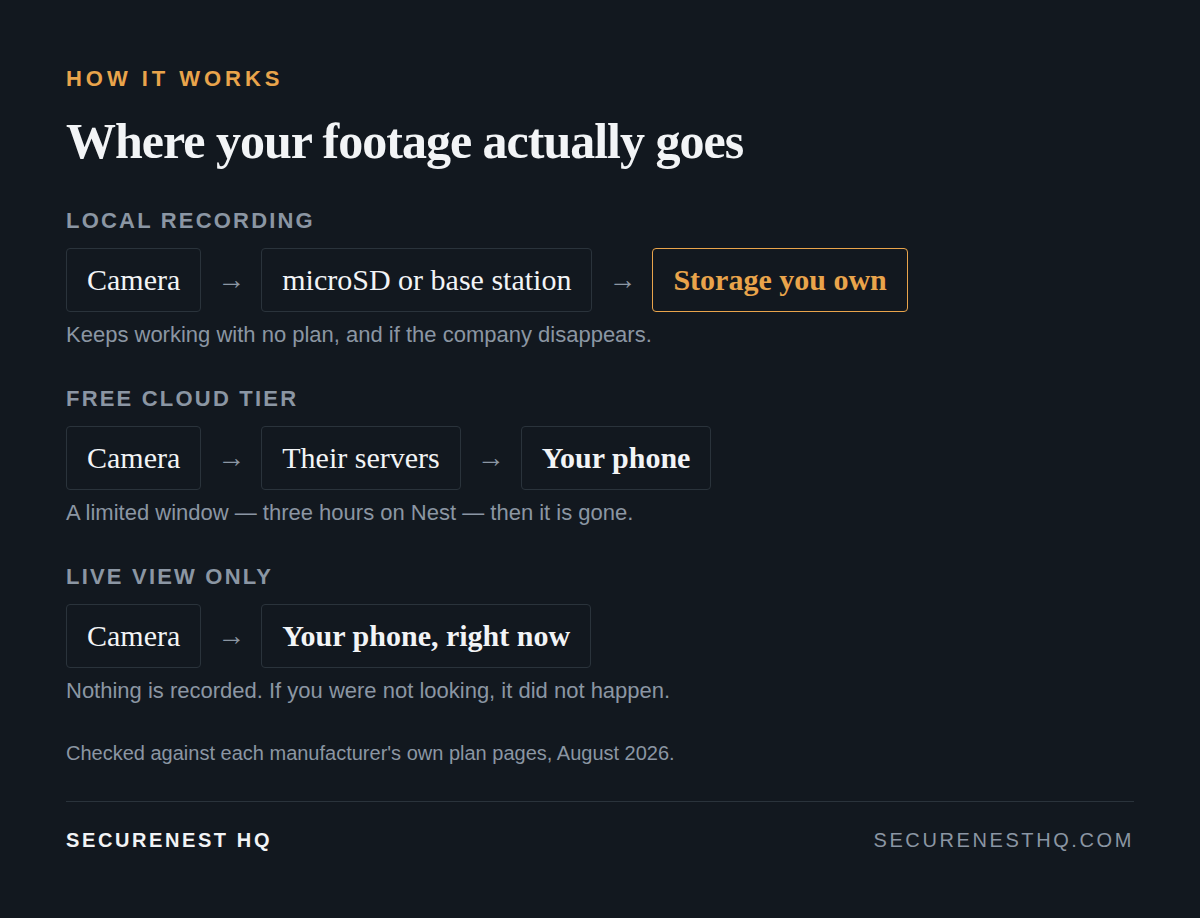
- Local recording. Video is written to a microSD card or a base station in your home. No plan, no cloud, no monthly cost, and it keeps working if the company disappears. Reolink, eufy and TP-Link Tapo sit here.
- A real free cloud tier. The camera records events to the manufacturer's cloud and lets you watch them back for a limited window without paying. Google's Nest cameras are the notable example.
- Live view only. The camera works, in the sense that you can open the app and see what is happening right now. Nothing is recorded. If you were not looking, it did not happen. Ring is the biggest name here.
All three get advertised as not requiring a subscription. Only the first two leave you with footage.
| Kind | What you get | Who |
|---|---|---|
| Local recording | Full video, on storage you own | Reolink, eufy, Tapo, Lorex |
| Free cloud tier | Limited window, their servers | Google Nest |
| Live view only | Nothing is saved at all | Ring |
What does Ring give you without a plan?
Live view, and essentially nothing else. Ring does not require a subscription to use its cameras and doorbells, but video history is a paid feature — without a plan, motion events are not saved and there is no recording to go back to.
Ring also renamed its plans on 14 January 2026, which is worth knowing if you are comparing against older articles that still use the previous names:
- Ring Solo — one device, up to 180 days of video event history
- Ring Multi — every device at one address
- Ring Pro — adds Familiar Faces, Video Search and 24/7 professional monitoring
Solo and Multi were called Ring Home Basic and Ring Home Standard until that date. None of the three has a price on Ring's own pages — Ring publishes 55,584 words about its plans and no price. If a comparison article still lists "Ring Protect Basic", it has not been updated in over a year.
What does Nest give you free?
Up to six hours of short video previews, or only snapshots — it depends on the model. Google's own help page, read 24 September 2026, gives three answers: up to 6 hours of event video previews on its newest wired cameras and doorbell, 3 hours on the battery Nest Cam and Nest Doorbell, and photo snapshots of the last 3 hours on most older models. Live view works on every model with no plan.
Two caveats that matter. First, no Nest camera supports local storage, so the free tier is Google's cloud on Google's terms and there is no offline fallback. Second, the paid tier changed name in 2026: Nest Aware has been replaced by Google Home Premium, with the Standard plan carrying 30 days of event history and Advanced 60 days.
Which cameras are genuinely subscription-free?
The ones that record to hardware you own. These have no recurring cost at all, and their detection runs on the camera rather than in a datacentre:
- Reolink Argus 4 Pro(paid link) — subscription-free across the range, with AI detection processed on the camera itself.
- eufy HomeBase 3 (S380)(paid link) — local storage, with HomeBase 3 acting as central storage for multiple cameras via SSD or hard drive.
- TP-Link Tapo C120(paid link) — microSD recording up to 512 GB, including 24/7 continuous capture on models such as the C120, with on-device person, pet and vehicle detection.
- Lorex — records to a microSD card or to a video recorder (NVR) you own. "No Monthly Fees" is Lorex's own banner, and its cloud plan is sold as an optional backup.
Arlo sits awkwardly between groups: the cameras work with no plan and no fee, but cloud recording and AI detection are both paid, which puts the practical experience closer to Ring's than the marketing suggests.
Wyze used to be the obvious budget answer here. It no longer is — Cam Plus Lite, the free tier, is closed to new users and never covered a camera released after April 2022, so a Wyze camera bought today keeps nothing in the cloud without a plan.
If that is the answer you came for, this is the camera behind it.
Check the price on AmazonReolink Argus 4 Pro(paid link)What does each plan cost over five years?
Nothing, if the camera records to a card or a hub you own. Otherwise $149.95 over five years for Wyze's cheapest plan, rising to $500 for Google's and $2,007.50 for SimpliSafe's — and Ring publishes no price to multiply.
| Item | Five-year cost | $ |
|---|---|---|
| Reolink, eufy, Tapo or Lorex — no plan | $0.00 | |
| Wyze Cam Plus, one camera | $149.95 | |
| Blink Basic, one camera | $199.95 | |
| Arlo Smart Aware, one camera | $479.40 | |
| Google Home Premium Standard, per home | $500.00 | |
| SimpliSafe Core, per home | $2,007.50 |
Each maker's cheapest published plan at its annual rate, times five, US pricing, from the maker's own page (dates in the table below). Ring is not here because it publishes no price. Hardware and memory cards are not included.
What does the cheapest plan cost, brand by brand?
Between $29.99 and $401.50 a year — and two of the ten will not tell you at all. That second half is the more useful finding, and it is why this table exists: every figure below came from the company's own page, and where there is no figure it is because the company does not publish one.
| Maker | Cheapest plan | Per year | Published? |
|---|---|---|---|
| Wyze | $2.99 / mo | $29.99 | Yes |
| TP-Link Tapo | $3.49 / mo | $34.99 | Yes |
| Blink | $3.99 / mo | $39.99 | Yes |
| eufy | $3.99 / mo | $39.99 | Yes — eufy.com/cloud-storage |
| Lorex | $5.99 / mo | $59.99 | Yes |
| Arlo | $9.99 / mo | $95.88 | Yes — us.arlo.com |
| Google Nest | $10 / mo | $100 | Yes |
| SimpliSafe | $1.10 / day | $401.50 | Yes, per day |
| Ring | not published | — | No — HTTP 406 |
| Reolink | not published | — | No — behind sign-in |
Read from each maker's own plan page on 20 August 2026; the Arlo and eufy rows were corrected on 27 August 2026. Both had been recorded here as publishing nothing, and both publish plainly — on pages this site did not have on file. SimpliSafe's yearly figure is ours: $1.10 × 365. Wyze's annual price is on its product page, not the plans page. Arlo began printing a yearly total in September 2026: $95.88, read 17 September. A dash means the company does not publish a price anywhere we can read.
Two things in that table are worth pausing on.
SimpliSafe prices by the day. $1.10 a day reads as the cheapest number on the page and is the most expensive plan on it — $401.50 a year, four times Google Nest and thirteen times Wyze. A daily price cannot be compared to a monthly one without doing the arithmetic yourself, which is the practical effect of quoting it that way.
Two companies do not publish a price. Ring returns HTTP 406 to anything that is not a person clicking, and Reolink moved its prices inside a signed-in application. None of that is an accident of the web, and it is a fact about a company you are about to give money to. Arlo and eufy were counted here too, until 27 August 2026 — wrongly, and the correction is ours rather than theirs: both publish plainly, on pages this site had not found.
So which one should you actually buy?
If you want footage without a monthly bill, buy a camera that records to a card or a hub you own — Reolink, eufy, Tapo or Lorex. That is the whole answer, and the condition attached to it is simple: you have to be willing to fetch clips yourself rather than have them waiting in an app.
The reasoning is in the table. Those four are the group whose cameras keep recording with no plan at all, so the yearly cost of ownership after the hardware is nothing. Everything else on this page is a plan you keep paying: $29.99 a year at the cheapest, $100 for Nest, $401.50 for SimpliSafe.
Buy the plan instead if an off-site copy matters more than the monthly cost. A card in a camera is stolen along with the camera. If that is the risk you are actually buying against — a break-in rather than a delivery driver — cloud storage solves the thing local recording cannot, and paying for it is the honest answer.
What we would not do is buy from a company that will not tell you what its plan costs until after you own the hardware. That is two of the ten above, Ring and Reolink — and it matters most for Ring, whose cameras keep nothing without the plan, while Reolink's need no plan in the first place. It is the one part of this decision you can settle before you spend anything.
What do you actually give up?
Usually convenience, occasionally the thing you bought the camera for. Local recording costs you remote access polish: retrieving clips can mean being on your own network, and there is no off-site copy if someone takes the camera and the card inside it. Cloud plans solve exactly that, which is the honest case for paying.
What is not a fair trade is discovering the distinction afterwards. A doorbell that only does live view is not a doorbell that tells you who took the parcel. It is a doorbell that would have, if you had been holding your phone.
If you rent, there is a second question before any of this: whether you are allowed to fit the thing at all. That is covered in what your lease actually says about cameras — and the answer turns on a clause most tenants have never read.
How do you check before you buy?
Manufacturers rarely lie about this, but they do bury it. Three questions answer it every time:
- Is there a microSD slot or a base station? No slot and no base means cloud, which means their terms and their pricing.
- What happens to recording when the plan lapses? Look for it on the plan comparison page, not the product page. If recording is listed as a plan feature, it is not a camera feature.
- Does detection run on the camera or in the cloud? On-camera detection keeps working when the subscription stops. Cloud detection does not.
Both big names renamed their plans recently. Google now calls Nest Aware "Google Home Premium", and Ring's plans became Ring Solo, Ring Multi and Ring Pro on 14 January 2026. Older articles still use the old names. What both companies publish now is in what these plans cost now, read from each company's own page and dated.
Where to find the subscription-free options
Specifications as published by each maker, read on 12 August 2026. Nothing here was tested and nothing is ranked.
- Form
- Outdoor camera on a bracket
- Power
- 5000 mAh battery, optional 6W solar panel
- Video goes to
- microSD in the camera, up to 512 GB
- Resolution
- 5120 × 1440 (8MP, 180° view)
- Subscription
- Not required for local recording
- Form
- Small cube on a magnetic base — stands on a shelf
- Power
- Mains, 5V adapter — needs a socket
- Video goes to
- microSD in the camera, up to 512 GB
- Resolution
- 2560 × 1440 (2K QHD, 4MP)
- Outdoors
- IP66 rated
- Form
- Base station for eufy cameras and sensors
- Storage
- 16 GB built in, expandable to 16 TB
- Expansion
- 2.5" SATA drive, 5V — 12V drives unsupported
- Capacity
- 16 eufy cameras or doorbells, plus 34 sensors
- Subscription
- No monthly fee for local storage
As an Amazon Associate I earn from qualifying purchases. This costs you nothing and never affects what is covered here.
How this was checked
Every price above was read on 20 August 2026 from the page the company publishes it on, in US pricing: Wyze (https://www.wyze.com/pages/service-plans), Blink (https://blinkforhome.com/plans), Tapo (https://www.tapo.com/us/tapocare/), Google Nest (https://store.google.com/us/product/nest_aware?hl=en-US), SimpliSafe (https://simplisafe.com/monitoring) and Lorex (https://www.lorex.com/pages/connect-cloud). Two could not be read and are recorded as unpublished rather than filled in from elsewhere: Ring (https://ring.com/pages/plans) returned HTTP 406, and Reolink (https://cloud.reolink.com/) renders but keeps its prices inside a signed-in application. Arlo and eufy were on that list until 27 August 2026 and should not have been: both publish plainly, at https://us.arlo.com/pages/arlo-secure and https://www.eufy.com/cloud-storage. In each case the evidence was a URL this site had on file returning nothing, which is a fact about our list and not about the company. SimpliSafe's yearly figure is our arithmetic on its published daily price: $1.10 × 365 = $401.50. No cameras were tested for this article — it is a question about what companies charge and permit, not about how well anything performs, and those are answered by reading rather than by unboxing. Updated 24 September 2026: Ring's plan prices were removed from this page, because Ring does not publish them; the Arlo row uses the yearly total Arlo began printing in September (https://us.arlo.com/pages/arlo-secure, read 17 September 2026); and the Nest free tier was re-read from https://support.google.com/googlenest/answer/9681538 on 24 September 2026.
This page is maintained. Plans get renamed, free tiers get quietly trimmed, and two of the changes above happened inside the last year — if something here no longer matches what you see, tell me and I will correct it and note the date.