Can a renter install a security camera? What your lease actually says
Usually yes — but four documents decide it, and your lease is only one. What to check before you fix anything to a wall you don't own.

Last updated · source-check dates are listed at the foot of this page
On this page
The drill is the moment you cannot take back.
Everything else about putting a camera in a rented flat is reversible. Peel the tape off, unplug the base, put it back in the box when you move. But a hole in someone else's door frame is a conversation with your landlord — and under most standard leases, one you were supposed to have in writing first.
Except the hole is not what gets people into real trouble. The microphone is.
Can a renter install a security camera?
Yes, in the general case — provided you do not modify the property. No federal law stops a tenant from putting a camera inside a home they rent, and the restrictions that bite in practice come from the lease rather than from statute.
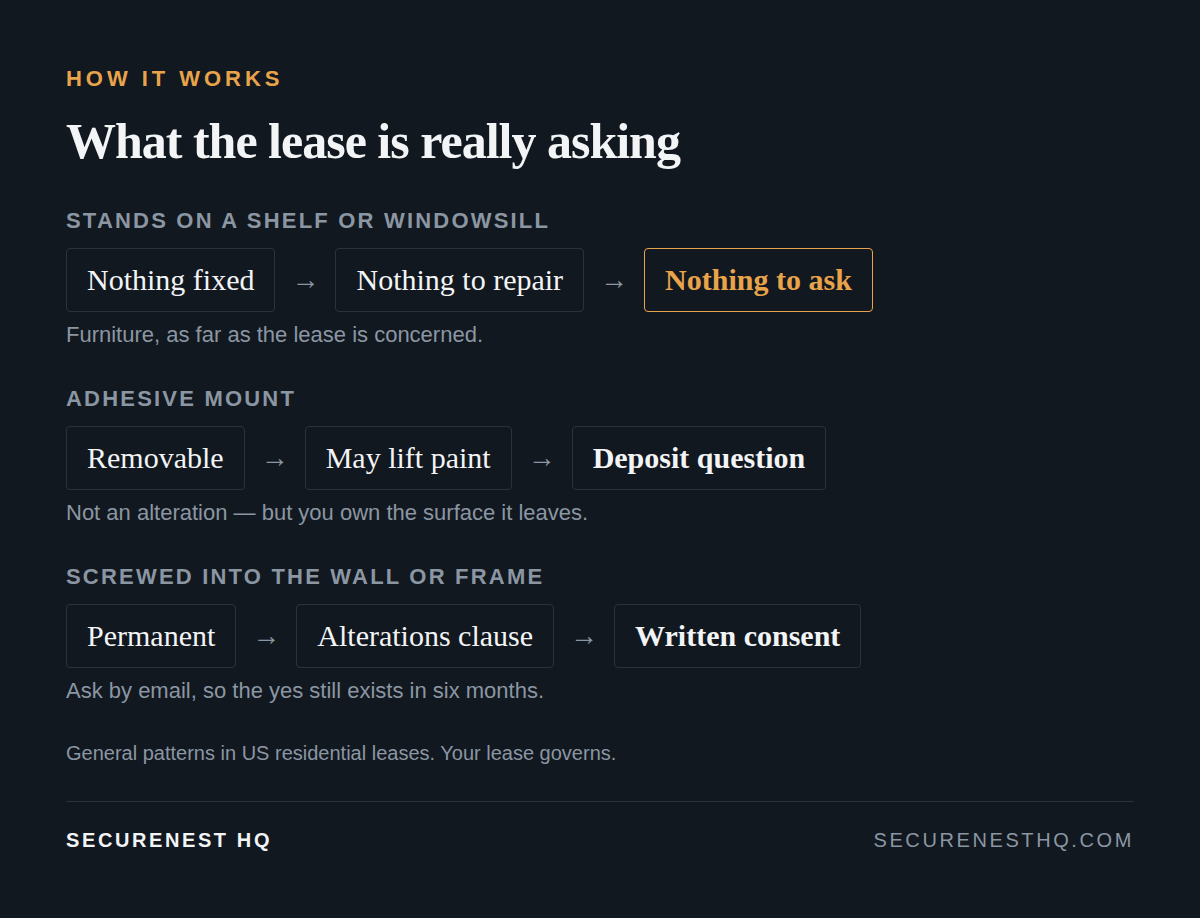
The line that matters is permanent versus removable. A camera standing on a bookshelf is furniture. The same camera screwed into the door frame is an alteration to someone else's property, and that is the thing your lease has an opinion about.
What does your lease actually say about it?
Look for the clause headed “Alterations”, “Improvements” or “Additions to the premises”. Standard residential leases in the US prohibit the tenant from altering, adding to or defacing the property without the landlord's prior written consent, and drilling into a wall or door frame is squarely inside that language.
Two more clauses are worth reading in the same sitting. The “Condition of premises” or “Surrender” clause usually requires you to return the property in its original state, ordinary wear and tear excepted. And the security deposit clause defines what the landlord may deduct for. Those three together, not the camera's marketing page, are what determine whether a mount is a problem.
If the lease requires written consent, ask by email rather than in person. A landlord saying yes is only useful later if you can produce it.
Does an adhesive mount count as damage?
Sometimes — adhesive is not automatically safe. Strong mounting tape can lift paint, varnish and wallpaper when removed, and a landlord is entitled to deduct for that in the same way as for a hole.
The practical difference is that adhesive is a deposit question rather than a consent question. Nothing has been permanently altered, so the alterations clause is not engaged; you are simply liable for whatever the surface looks like when the tape comes off. Textured, painted and older surfaces are where this goes wrong. Smooth uPVC, glass and metal are where it usually does not.
Can your camera legally record audio?
This is the part almost every “best cameras for renters” article skips, and it is the one with criminal penalties attached. Video and audio are governed by different rules, and most modern cameras record both by default.
Federally, the Wiretap Act allows recording where one participant consents. 18 U.S. Code § 2511(2)(d) puts it this way:
“It shall not be unlawful under this chapter for a person not acting under color of law to intercept a wire, oral, or electronic communication where such person is a party to the communication or where one of the parties to the communication has given prior consent to such interception…”
Twelve states require every participant to consent instead. Recording a conversation you are not part of — which is exactly what a doorbell camera does while you are out — is lawful in one state and a crime in the next. Federal penalties under § 2511 run to five years and statutory damages from $10,000.
States commonly listed as all-party consent
- California
- Connecticut
- Delaware
- Florida
- Illinois
- Maryland
- Massachusetts
- Montana
- New Hampshire
- Oregon
- Pennsylvania
- Washington
The exact count is disputed, and honestly so: Connecticut applies all-party consent to phone calls but not to in-person conversation under its criminal statute, and Oregon splits between in-person and electronic communication. Treat the list as “check your own state's statute”, not as settled.
The fix is a setting. Most cameras let you disable the microphone outright, and a visible “audio and video recording in use” notice is the conventional way of putting visitors on notice where all-party consent applies. If you rent, the microphone is the first thing worth turning off.
Where are you allowed to point it?
At your own door and inside your own home — and that is roughly where it stops. A camera covering a shared hallway, a neighbour's door or anyone's window moves from your property into theirs, and the reasonable-expectation-of-privacy question follows it.
Shared entrances are the common trap in apartment buildings. A doorbell camera aimed down a communal corridor records every other resident coming and going, and building rules often address that specifically even when the lease does not. Interior common areas, laundry rooms and lifts belong to the building, not to you.
Can your landlord put cameras in the building?
In common areas, usually yes; inside your unit, no. A landlord may generally monitor entrances, car parks and shared corridors, and may not place a camera anywhere a tenant has a reasonable expectation of privacy — which includes the inside of the home, and unambiguously includes bathrooms and bedrooms.
Furnished and short-let properties are where this surfaces. If a smart device came with the property, the questions worth asking in writing are who holds the account, whether it records, and where the footage is stored. The answer belongs in your correspondence, not in your memory.
Which documents actually decide it?
Not one of these is the camera's manual, and none of them is a blog post — including this one. Read them in this order.
| Document | What to look for | What it settles |
|---|---|---|
| Your lease | “Alterations” / “Additions” | Whether you may fix anything |
| Your lease | Security deposit clause | What a mark costs you |
| Building or HOA rules | Shared-area policy | Doorbells and corridors |
| Your state statute | Recording consent | Whether audio is legal |
What kind of camera fits a rental?
The constraint does the choosing here. If nothing may be permanently fixed, the options are cameras that need no mount, mounts that need no holes, and devices that need no wiring — and that is a much shorter list than “best security cameras”.
Cameras that record to a card in the device, like the TP-Link Tapo 2K QHD indoor/outdoor camera(paid link), also sidestep the other renter problem: a subscription you keep paying after you move. That is the subject of our piece on which cameras work without a plan, and the overlap with renting is not a coincidence.
These are linked because they match the constraint above, not because they were tested here. Nothing on this site is ranked.
One thing a camera will not fix, whatever your lease says: parcels disappearing from a shared lobby. That problem has its own answer in how to stop package theft in an apartment, and most of what works there is free.
Kit that matches the constraint
Specifications as published by each maker, read on 12 August 2026. Nothing here was tested and nothing is ranked.
- Form
- Small cube on a magnetic base — stands on a shelf
- Fixing
- None required; magnetic, or screws if you want them
- Power
- Mains, 5V adapter — needs a socket
- Video goes to
- microSD in the camera, up to 512 GB
- Outdoors
- IP66 rated
- Form
- Adhesive plate that a battery doorbell clips onto
- Fixing
- 3M adhesive — no holes in the frame
- Power
- None; the doorbell keeps its own battery
- Best on
- Smooth surfaces — uPVC, painted metal, glass
- Form
- Outdoor camera on a bracket
- Fixing
- Bracket needs mounting — check your lease first
- Power
- 5000 mAh battery, optional 6W solar panel
- Video goes to
- microSD in the camera, up to 512 GB
- Subscription
- Not required for local recording
As an Amazon Associate I earn from qualifying purchases. This costs you nothing and never affects what is covered here.
How this was checked
The federal consent rule is quoted directly from 18 U.S. Code § 2511(2)(d) as published by the Cornell Legal Information Institute at https://www.law.cornell.edu/uscode/text/18/2511, read on 11 August 2026 and re-checked on 28 August 2026, when the quoted consent language was still on that page. The all-party consent state list and the Connecticut and Oregon exceptions were taken from published state-law summaries on the same date; where those summaries disagree on the total, that disagreement is reported above rather than resolved. Those summaries were not recorded individually at the time, which is a gap in this page's sourcing rather than in the law: the statute above is citable, the state list is not, and it is named here so a reader can weigh the two differently.
Lease language is described in general terms because there is no single US residential lease — the clause names given are the ones that recur, not quotations from any one document. No cameras were tested for this article, and no legal advice is given. Jurisdiction decides this, and your paperwork decides it before any statute does.
Corrections
If something here is wrong or has changed — a state statute, a consent rule, a link that no longer resolves — tell us and it gets fixed with the date noted. Pages here are maintained rather than published and abandoned.