How to stop package theft in an apartment
Most advice assumes you own the porch. In a flat you control almost nothing at the door — so the leverage is earlier, before it arrives.

Last updated · source-check dates are listed at the foot of this page
On this page
The lobby door swings shut behind the driver, and your parcel is now sitting in a room that thirty other people have a key to.
That is the part of a flat you cannot fix, and nearly every article on package theft quietly assumes you can: a lockbox bolted to a porch, a camera screwed in above a door, a smart lock you are not permitted to fit.
Worse, the free fix everyone recommends first may not work at your address at all. USPS says on its own signup page that some flats and condos lack a uniquely coded address and cannot use Informed Delivery. No article recommending it mentions that.
How often does package theft actually happen?
Nobody knows precisely, and the published numbers disagree with each other by a factor of two. That disagreement is more useful than any single figure, because it tells you how much confidence the number deserves.
| Source | Reports | Counting |
|---|---|---|
| Capital One Shopping | 228 million/yr | packages |
| SafeWise 2025 report | 104 million/yr | packages |
| Omnisend survey, Mar 2026 | 30% of households | households, n=1,000 |
The gap is not carelessness. Some studies count packages and some count households; some survey a few hundred people and some several thousand; every one relies on self-reporting, and nobody reports a parcel that was simply lost by the carrier as anything other than stolen. Security.org and SafeWise both publish annual reports and arrive at different answers.
Treat any single statistic in an article about porch theft — including the ones above — as an estimate with a wide margin, particularly when the site quoting it sells something.
Why doesn't the usual advice work in an apartment?
Because it assumes you control the delivery point, and in a flat you control almost none of it. A parcel left in a shared lobby is sitting in a space the building owns, often behind a door that dozens of people and every delivery driver can open.
Run the standard checklist against a rented flat and most of it fails immediately. A lockbox needs somewhere to bolt it. A camera pointed down a communal corridor records every neighbour coming and going, which building rules frequently address even when the lease does not — the same problem covered in what your lease actually says about cameras. A smart lock is an alteration you are not permitted to make.
What is left is the part of the journey that happens before the driver arrives, and that part is yours.
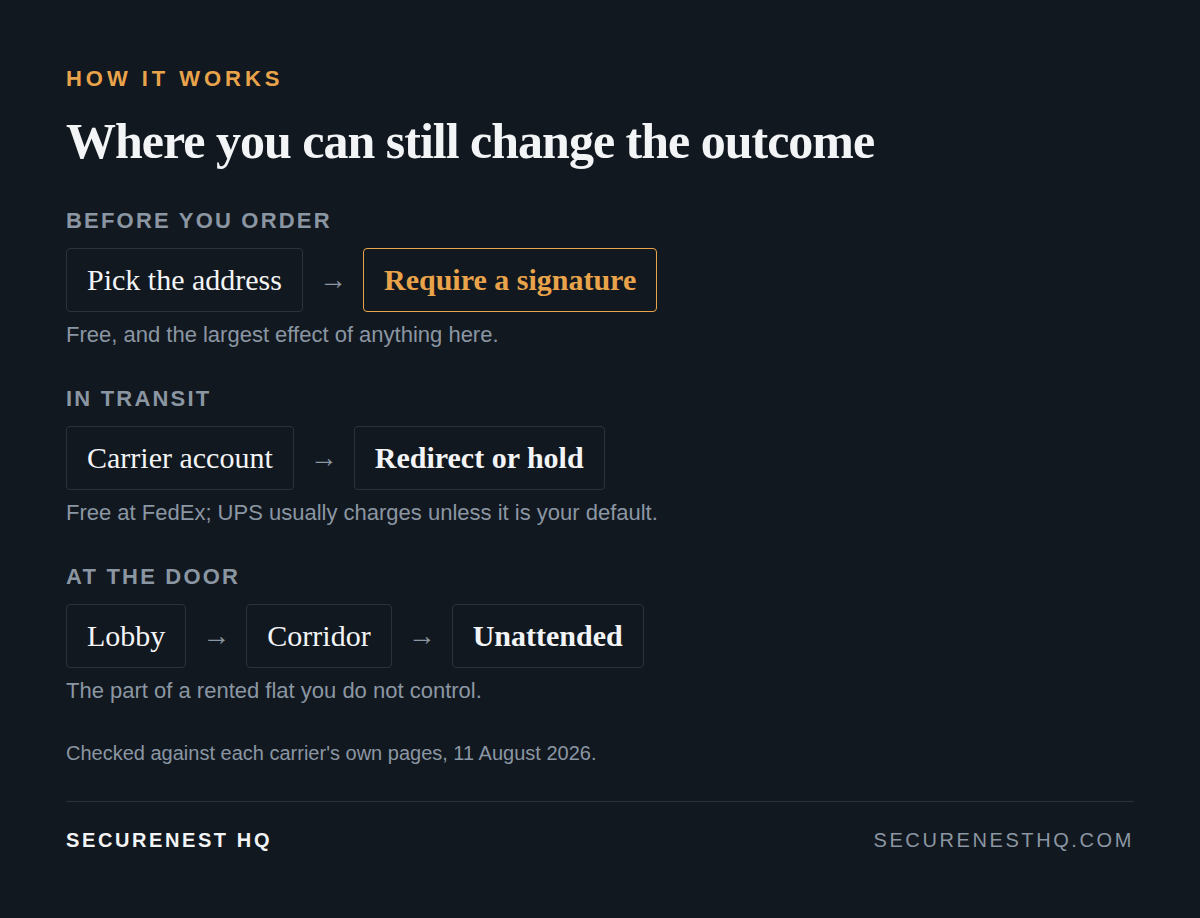
What can you change before the package arrives?
The delivery address, the delivery date and whether a signature is required — all decided before dispatch, and all free at the point you place the order. Every intervention gets more expensive and less effective the later you make it.
Ordering to a workplace, choosing a longer delivery window when you know you will be home, and splitting a large order so it does not arrive as an obvious stack of boxes all cost nothing. Requiring a signature is the most effective option and the most annoying, which is why almost nobody uses it.
Once a parcel is moving, your options narrow to what the carrier allows, and that is where the differences show up.
| Carrier | Free tier | The catch |
|---|---|---|
| USPS Informed Delivery | Digest, delivery instructions | Some flats are ineligible |
| FedEx Delivery Manager | Hold at a FedEx location | Request by the day before |
| UPS My Choice | Basic membership | Redirects usually cost extra |
| Amazon Hub locker | Free pickup | Not all sellers can ship there |
Does USPS Informed Delivery work in an apartment?
Sometimes — and this is worth checking before you rely on it. USPS states that some apartment buildings and condos do not have uniquely coded addresses, which can make the address ineligible for the service entirely.
That caveat is on the USPS enrolment page and appears in almost no article recommending Informed Delivery as a package-theft measure. When it does work it is free and genuinely useful: a daily digest showing what is arriving, plus delivery instructions and redelivery scheduling for eligible packages. Check your own address during signup rather than assuming.
Where else can a package be delivered?
To a carrier pickup point, a parcel locker, or a staffed desk — which is the only approach that removes the unattended doorstep altogether. Everything else reduces the odds; this changes the geometry.
FedEx Delivery Manager is free and can hold a parcel at a FedEx location, though the redirect must be requested by the end of the business day before delivery is scheduled, and the package waits five business days for you and your ID. UPS My Choice has a free tier, but redirecting to another address or to an Access Point generally carries a fee unless you set a pickup point as your standing preference — check the current charge, because it is the kind of thing that changes.
Amazon Hub lockers are free and the most convenient of the three if you are mostly ordering from Amazon. The limitation is that third-party sellers shipping by other carriers, or anything requiring a signature, cannot be sent to one.
Does a camera stop package theft?
No, and it is worth being blunt about that. A camera records a theft that has already happened; it does not prevent one, and the footage will rarely get the parcel back.
What it does is produce evidence, which has real uses: a police report, a carrier dispute, an insurance claim, or a building manager who needs convincing that there is a problem in the lobby. If that is why you want one, it is a reasonable purchase. If you are buying it expecting the parcels to stop disappearing, it is not.
In a rented flat, pointing it is the harder question. A camera covering your own door is straightforward; one covering a shared corridor is recording your neighbours, and audio recording brings a separate set of rules covered in the renting piece above.
What actually fits an apartment?
Worth stating plainly: the measures with the largest effect in this article are free. Redirecting delivery, requiring a signature and using a locker outperform any device, and none of them is a purchase.
The two things below are linked because they solve the documentation problem without permanently altering a rented flat — not because they stop a theft. Nothing here was tested, and nothing is ranked.
If you want the documentation
Specifications as published by each maker, read on 12 August 2026. Nothing here was tested and nothing is ranked.
- Form
- Small cube on a magnetic base — stands on a shelf
- Fixing
- None required; magnetic, or screws if you want them
- Power
- Mains, 5V adapter — needs a socket
- Points at
- Your own door only — a corridor records neighbours
- Form
- Adhesive plate that a battery doorbell clips onto
- Fixing
- 3M adhesive — no holes in the frame
- Power
- None; the doorbell keeps its own battery
- Best on
- Smooth surfaces — uPVC, painted metal, glass
As an Amazon Associate I earn from qualifying purchases. This costs you nothing and never affects what is covered here.
How this was checked
Informed Delivery's terms, including the uniquely-coded-address caveat, were read on usps.com on 11 August 2026. FedEx's Hold at Location terms and the next-business-day redirect deadline come from fedex.com on the same date. Amazon Hub locker limitations come from Amazon's own help pages. UPS My Choice fees are described in general terms rather than quoted, because UPS's own page did not load when checked and a fee taken from a third-party summary is not good enough to print as fact.
The theft estimates are drawn from published 2025 and 2026 reports by Security.org, SafeWise and Capital One Shopping, which is why they disagree — that disagreement is reported rather than resolved. No cameras or lockers were tested for this article.
Corrections
If a carrier changes a policy or a figure here goes out of date, tell us and it gets corrected with the date noted. Pages here are maintained rather than published and abandoned.